
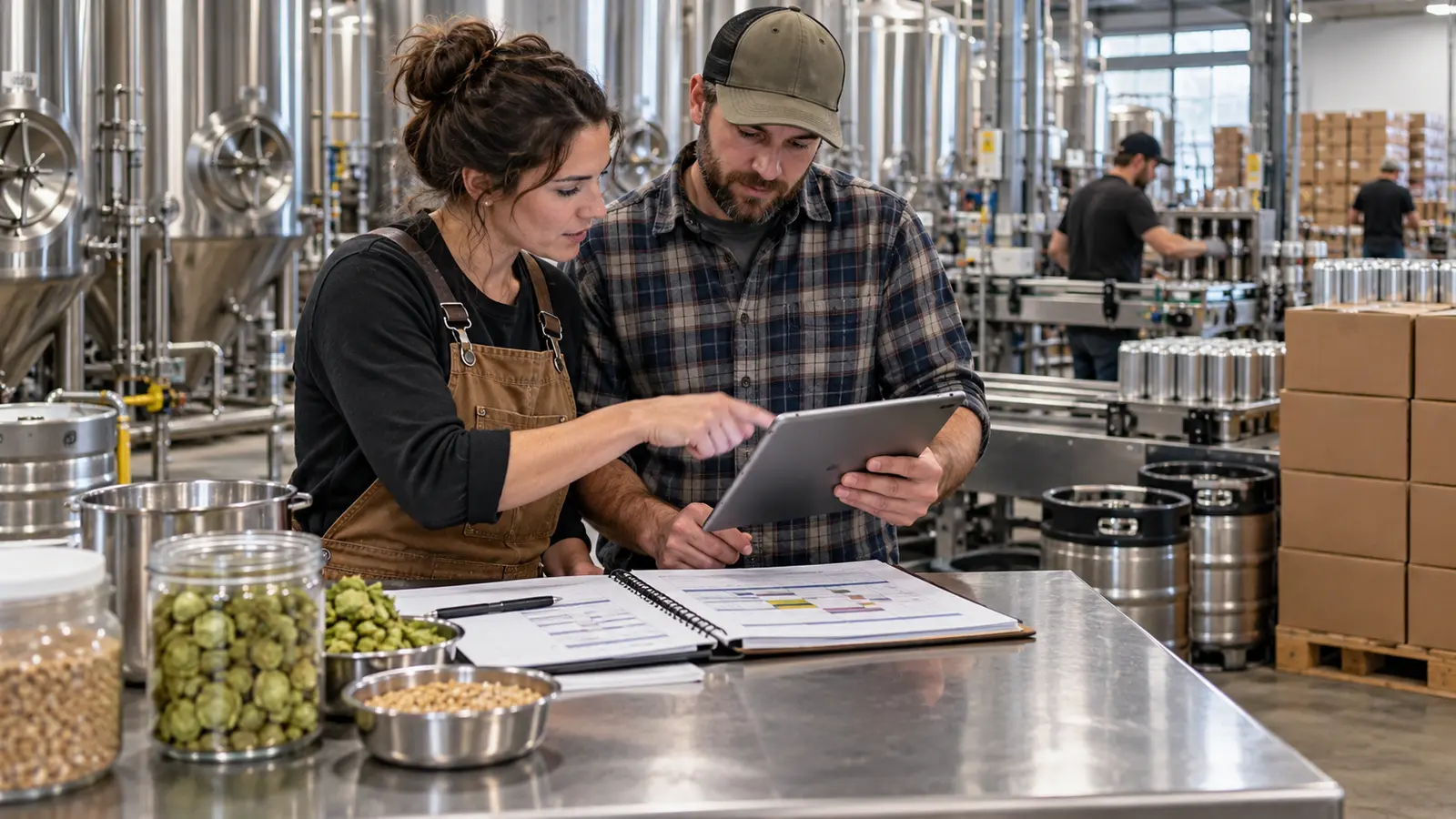
Breweries and distilleries can commit cash to ingredients, production labor, tanks, barrels, packaging and excise obligations well before wholesale invoices are collected. A useful funding request separates taproom, tasting-room and wholesale economics, then connects the amount requested to documented production capacity, saleable yield and a conservative collection plan.
Define the producer model and exact funding request
Describe whether the business operates a brewery, brewpub, distillery, tasting room, contract-production arrangement, self-distribution model where permitted, wholesale brand or multiple locations. Separate production from hospitality or retail operations.
State whether the request is for a brewhouse, still, tanks, barrels, packaging line, cold storage, utilities, ingredients, packaging, payroll, a taproom or tasting-room project, acquisition, receivables timing or operating working capital. Prepare a detailed sources-and-uses schedule.
The CashMigo brewery and distillery funding page provides a focused starting point. Tie the amount to a documented bottleneck, accepted demand and conservative collected cash rather than projected consumer interest alone.
Separate taproom and wholesale cash flow
Prepare monthly sales and collected-cash reports for taproom or tasting-room service, packaged retail, club or membership programs, events, self-distribution where permitted, distributor sales, contract production and other revenue lines.
Map card-settlement timing, distributor terms, invoice deductions, returns, credits, chargebacks, depletion allowances and disputed balances. Sales shipped or reported are not the same as cash collected.
Measure gross contribution by channel after ingredients, packaging, production labor, excise taxes, freight, distributor or retailer economics, hospitality labor, card fees and other direct costs.
Tell CashMigo what the business needs, how much and how soon. We will review the request and help identify potential next steps.
Check My Funding Options →Measure batch yield and production economics
Build batch records that reconcile ingredients and liquid input with fermentation, distillation, transfer, aging, packaging, samples, breakage, rework, loss and saleable finished output. Use the units appropriate to the operation.
Calculate contribution by product, package and channel after direct materials, labor, utilities, cooperage, packaging and contract services. Explain products whose aging, conditioning or quality cycle delays sale.
Model the incremental output from the proposed investment. Added tanks or line speed only create value when upstream production, cold storage, labor, packaging, distribution and demand can support them.
Find the real capacity constraint
Map brewhouse or still runs, fermentation and brite tanks, barrel or storage capacity, filtration, carbonation, cold storage, canning, bottling, kegging, labeling and warehouse movement as applicable.
Measure scheduled and actual utilization, turnaround, cleaning, changeover, downtime, maintenance and quality holds. A constraint can move from cellar capacity to packaging, utilities, cold storage or sales once new equipment arrives.
Connect each proposed asset with a documented bottleneck, replacement need, avoided contractor cost or accepted customer demand. Do not justify equipment solely with maximum rated speed.
Evaluate equipment and installation
List tanks, brewhouse, still, mill, boiler, chiller, glycol, pumps, compressors, filtration, packaging, labeling, coding, conveyors, forklifts, cold storage and laboratory equipment with age, condition, ownership, liens and maintenance history.
For each purchase, include freight, rigging, foundation, drainage, ventilation, electrical, gas, steam, water, wastewater, fire protection, controls, commissioning, training, spares and contingency.
Confirm compatibility with the premises, process and expected throughput. Equipment funding does not establish engineering, fire, building, environmental, alcohol or workplace compliance.
Plan ingredients, packaging and inventory
Prepare inventory by raw materials, packaging, work in process, bulk or aging liquid, finished goods and merchandise. Show quantity, cost, location, age, salability and any restrictions on use or transfer.
Map supplier minimums, lead times, seasonality, deposits and price exposure for grain, hops, fruit, botanicals, yeast, barrels, glass, cans, ends, labels, cartons, kegs and other inputs as applicable.
Avoid funding an inventory build without a release plan. Aging, seasonal, limited-release or slow-moving product can consume cash and storage while packaging changes, quality issues or demand shifts reduce realizable value.
Document distributor receivables carefully
Prepare an aging by distributor or customer with invoice date, delivery, acceptance, due date, deductions, credits, disputes, returns and subsequent collections. Reconcile it with the general ledger and bank deposits.
Review customer concentration, territory, appointment or franchise arrangements, assignment restrictions, payment practices and termination rights with qualified professionals. Alcohol distribution rules and agreements vary by jurisdiction.
Invoice factoring may be considered for qualifying receivables, but eligibility depends on the customer, invoice, delivery, contract, jurisdiction, existing liens and provider requirements. Not every invoice will qualify.
Model excise-tax and reporting timing
Map when finished product becomes taxable, when removals or other taxable events occur, applicable returns or reports, payment timing and cash reserves with qualified tax and alcohol-industry professionals.
TTB states that brewers may have federal excise-tax obligations and must maintain specified operational and inventory records. Filing and payment frequency depends on the business's circumstances and current requirements.
Funding does not determine excise-tax liability, filing frequency or eligibility for any rate or credit. Use current TTB, state and local guidance and qualified professionals rather than relying on a financing forecast alone.
Keep licensing and change approvals separate
Prepare a non-sensitive summary of federal, state and local permits, notices, licenses, premises approvals and authorized operations. Identify pending applications, amendments, renewals or material conditions.
TTB says a distilled spirits business must qualify before operating, and entity or commodity-operation changes can require amendments. State and local production, distribution, retail, food-service, zoning and health requirements may also apply.
Funding does not authorize alcohol production, storage, sale, distribution, import, export or service. Do not commit to a closing, location, ownership change or production plan without confirming required approvals and timing.
Evaluate taproom or tasting-room improvements
Separate production needs from guest-facing construction, draft or dispense systems, kitchen, furniture, point of sale, accessibility, restrooms, outdoor areas, signage and event space.
Model guest counts, average collected check, product mix, labor, food or outside-vendor costs, events and seasonality. Hospitality revenue should not be assumed to rise automatically because production capacity increases.
Document ownership or lease rights, permitted use, landlord consent, plans, utilities, insurance, permits, construction schedule, contingency and downtime. Budget working capital through reopening and ramp-up.
Evaluate an acquisition or brand purchase
Separate equipment, inventory, real estate or lease, licenses, permits, formulas, trademarks, distribution rights, contracts, receivables, workforce, finished goods and assumed liabilities. Confirm transferability and required approvals.
Reconcile seller financials with production records, inventory, excise filings, distributor statements, point-of-sale reports, invoices, bank deposits, payroll, utilities, maintenance and tax returns.
Build a transition plan for ownership or control approvals, premises, licensed operations, distributors, key staff, raw materials, product registrations or labels, systems and working capital. Purchase price is not the full cash requirement.
Keep formulas and credentials secure
Use summarized production, financial, capacity and inventory information for the initial funding discussion. Do not place proprietary formulas, detailed process records, permit credentials, distributor portals, payment data or security information in the general form.
Prepare a non-sensitive summary of formula and recipe ownership, trademark rights, record access, production-system permissions, payment security and facility controls. Share detailed records only when necessary through an approved secure process.
Funding does not establish intellectual-property, privacy, cybersecurity or records compliance. Confirm applicable protections with qualified legal, technology, insurance and industry professionals.
Build a 13-week cash-flow forecast
Map taproom settlements, distributor collections and other operating receipts against ingredients, packaging, payroll, utilities, rent, excise taxes, freight, maintenance, insurance, current obligations and proposed payments by week.
Create downside cases for slower taproom traffic, distributor delay, lower batch yield, packaging loss, equipment failure, ingredient shortage, inventory hold, licensing delay, construction overrun and customer concentration.
Place the proposed payment after essential production, tax, payroll, utilities, maintenance, safety and working-capital needs. If the plan depends on perfect yield, immediate sell-through or collection of disputed invoices, reduce the amount or reconsider the structure.
Prepare a clear, secure starting file
Useful starting records may include recent bank statements, year-to-date and prior-year financials, revenue by channel, product or package margins, batch yield, tank and line capacity, equipment, inventory, distributor receivables, payroll, utilities, excise-tax summary, current obligations and a sources-and-uses schedule.
Add detailed formulas, permits, acquisition records, distributor agreements, tax filings and other confidential diligence only when requested through an approved secure channel. Explain material recalls, quality holds, disputes, permit issues, equipment failures or tax arrears directly.
Begin through CashMigo's 60-second funding check using non-sensitive business information. Never submit formulas, permit-account credentials, distributor logins, payment-card data, bank credentials or facility access codes through the general form.
Compare structure and payment pressure
Compare gross amount, deductions, net proceeds, total cost, payment amount and frequency, term or expected duration, collateral, liens, guarantees, covenants, default terms, renewal conditions and early-payoff treatment.
Place the proposed payment into normal, seasonal, distributor-delay, lower-yield, equipment-failure and licensing-delay forecasts after ingredients, payroll, utilities, excise taxes, maintenance and essential controls.
Review financing, alcohol operations, tax, distribution, equipment, construction and acquisition decisions with qualified legal, accounting, tax, insurance, engineering and beverage-industry professionals. Speed should not replace a complete evaluation of economics and risk.
Frequently asked questions
Can brewery or distillery equipment be financed?
Potentially. Providers may review the equipment, vendor, price, age, condition, installation, utilities, useful life, applicant profile, credit, cash flow and provider requirements.
Can funding support ingredients and packaging?
Potentially. Providers may review accepted demand, supplier terms, production plan, batch yield, inventory, shelf or aging cycle, margin, collection timing and applicant profile.
Why are taproom and distributor revenue reviewed separately?
They can have different sales, margin and collection patterns. Taproom receipts may settle quickly, while wholesale invoices may involve payment terms, deductions, returns, disputes and concentration.
Can eligible distributor invoices be factored?
Potentially. Providers may review distributor credit, invoice eligibility, delivery and acceptance, contract or legal restrictions, returns, credits, disputes, concentration and existing liens. Not every invoice will qualify.
Does funding establish alcohol licenses or permit approval?
No. Funding is separate from federal, state and local permits, notices, licenses, premises approvals, taxes, reports, product or label requirements and other operational obligations.
